Highlights include keynote on "China's Global Governance Initiative", two timely panel discussions
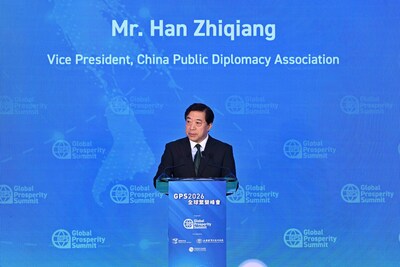
HONG KONG, May 19, 2026 /PRNewswire/ -- The organisers of Global Prosperity Summit 2026 (GPS 2026) announced that the event's third consecutive edition opened today, shining spotlights on issues critical to Hong Kong's future development and global prosperity. Ambassador Han Zhiqiang, Vice President of the China Public Diplomacy Association, delivered a keynote address that offered profound and forward-looking insights into China's Global Governance Initiative.
In his keynote speech entitled "China's Global Governance Initiative", Ambassador Han Zhiqiang said:
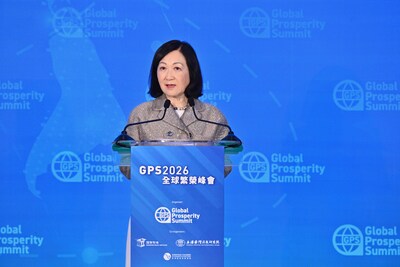
In her welcome remarks, Mrs Regina Ip, Founder of the Global Prosperity Summit and Chairperson of the Board of Governors of the Savantas Policy Institute, said, "The Summit can serve as a platform for dialogue, exchange and pragmatic cooperation. Our discussions will focus on the profound economic, technological and scientific transformations reshaping the world before our eyes. Amid uncertainties, Hong Kong continues to stand out as an oasis of stability, connectivity and opportunity."
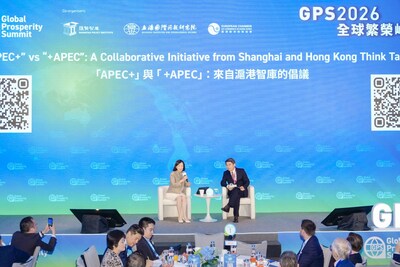
Mrs Regina Ip and Professor Kaisheng Li, Vice-President of the Shanghai Institutes for International Studies, also delivered a joint briefing titled "'APEC+' vs '+APEC': A Collaborative Initiative from Shanghai and Hong Kong Think Tanks", with the following key points:
The opening day of GPS 2026 also featured two panel discussions: "Innovative Drug Development in the Guangdong–Hong Kong–Macao Greater Bay Area" and "Hong Kong as a Sports, Cultural and Recreational Hub".
In addition, Mr Septime Webre, Artistic Director of the Hong Kong Ballet, gave a presentation on "Telling Hong Kong's Story through Art".
The Summit will continue tomorrow.
Jointly organised by the Savantas Policy Institute, the Shanghai Institutes for International Studies, and the European Chamber of Commerce in Hong Kong, GPS 2026 features a dynamic programme of forward‑looking discussions. Now in its third consecutive year, the Summit continues to strengthen Hong Kong's role as a leading platform for cross‑disciplinary dialogue.
About Global Prosperity Summit
The Global Prosperity Summit was initiated by a group of business leaders, academics and experts in Hong Kong to provide a platform for frank, objective and rational discussion of key issues shaping global prosperity. The inaugural Summit was held in Hong Kong in 2024.
About Savantas Policy Institute
The Savantas Policy Institute (SPI) was established in 2006 by a group of Hong Kong residents with international experience who are committed to the city's future development. SPI's mission is to support Hong Kong's transition into a knowledge-based economy through public policy research, strategic recommendations, and the promotion of public understanding and participation in economic and social development.
About Shanghai Institutes for International Studies
Established in 1960, the Shanghai Institutes for International Studies (SIIS) is a leading think tank dedicated to research on international politics, economics and security. It plays an important role in providing policy recommendations and advancing understanding of global affairs and is widely recognised as one of China's most influential research institutions.
About European Chamber of Commerce in Hong Kong
Established in 1997, the European Chamber of Commerce in Hong Kong (EuroCham) is a non-governmental business interest group comprising 16 European chambers based in Hong Kong. Representing over 1,600 European companies operating in the city, EuroCham promotes European business interests and strengthens economic ties between Europe and Hong Kong. Europe is Hong Kong's second-largest trading partner after the Chinese Mainland.

 View original content to download multimedia:https://www.prnewswire.co.uk/news-releases/two-day-global-prosperity-summit-2026-officially-opens-302776474.html

In Thüringen ist ein großangelegtes Forschungsprojekt zur nächsten Generation der Nanostrukturierung gestartet. Wissenschaftlerinnen und Wissenschaftler der Technischen Universität Ilmenau, der Friedrich-Schiller-Universität Jena und des Fraunhofer-Instituts für Angewandte Optik und Feinmechanik (IOF) in Jena entwickeln gemeinsam eine Hochpräzisionsmaschine, die Nanostrukturen auf Flächen von bis zu einem Quadratmeter erzeugen und vermessen soll. Die geplante 3D-Nanolithographie- und Nanomessmaschine (3D-NLM) soll dabei eine Positionierungsgenauigkeit erreichen, die kleiner ist als ein Atom. Die Deutsche Forschungsgemeinschaft (DFG) unterstützt die erste Projektphase bis 2027 im Rahmen des Programms „Neue Geräte für die Forschung“ mit vier Millionen Euro.
Mit dem Vorhaben zielt das Konsortium auf eine Größenordnung, die bestehende Anlagen deutlich übertrifft. Bisher lassen sich hochpräzise Nanostrukturen auf photonischen Bauteilen nach Angaben der Projektbeteiligten nur bis zu einem Durchmesser von etwa 30 Zentimetern zuverlässig herstellen. Die neue Anlage soll Bearbeitungen und Messungen von Bauteilen mit Kantenlängen von bis zu einem Meter ermöglichen – und damit eine mehr als dreifache Vergrößerung der nutzbaren Fläche erschließen. Die Entwicklungsarbeiten an der Maschine sind angelaufen; das Gesamtprojekt ist in drei Phasen bis 2032 angelegt.
Nanostrukturen gelten seit rund zwei Jahrzehnten als Schlüsseltechnologie, weil sie Licht gezielt beeinflussen können, indem sie dessen Wellenlänge und Ausbreitung steuern. Solche Strukturen finden sich bereits heute in großflächigen Bauteilen, etwa in Displays moderner Fernsehgeräte, die auf Nanotechnologie basieren. Nach Einschätzung der Forscherinnen und Forscher reicht die Genauigkeit bestehender industrieller Lösungen jedoch nicht aus, um künftige Anforderungen in zentralen wissenschaftlichen und technologischen Anwendungsfeldern zu erfüllen.
Die in Thüringen entstehende 3D-NLM soll genau diese Lücke adressieren. Perspektivisch könnte die Maschine zur Fertigung und Charakterisierung elektronischer und photonischer Schaltkreise ebenso eingesetzt werden wie zur Herstellung von Hochleistungsoptiken für die Erdbeobachtung. Auch in der Energieforschung sehen die Projektpartner potenzielle Einsatzfelder. Durch die Kombination aus großflächiger Bearbeitung und atomnaher Präzision erhoffen sich die Beteiligten einen technologischen Sprung, der sowohl der Grundlagenforschung als auch der Entwicklung neuer Komponenten in der Optik- und Elektronikindustrie zugutekommen könnte.