CHANGZHOU, China, Aug. 27, 2026 /PRNewswire/ -- Recently, S&P Global released its second Tier 1 Cleantech Companies List, covering PV modules, PV inverters, wind turbines, energy storage systems, and energy storage battery cells. Trinasolar has once again been named as Tier 1 for both PV modules and energy storage systems. This consecutive inclusion recognizes Trinasolar's leading system integration capabilities, strong market presence, and commitment to sustainable practices.
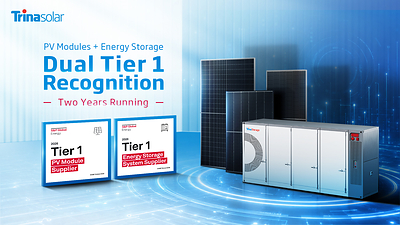
S&P Global Energy's Tier 1 Cleantech Companies classification evaluates global manufacturers across six key dimensions including market presence, market share, scale, global diversification, financial performance, and sustainability factors.
For 29 years, Trinasolar has been at the forefront of PV innovation. As a pioneer in n-type TOPCon industrialization, Trinasolar's Vertex N G3 module reaches a maximum power output of 760 W, offering high bifaciality, strong low-irradiance performance and reliability for utility-scale projects. At the same time, Trinasolar is advancing its THBC technology, forming a dual-engine model driven by both TOPCon and THBC across utility-scale and non-utility applications. By the end of 2025, Trinasolar's cumulative 210mm module shipments secured its position as the global No. 1. With customer-focused solutions for desert scenario and extreme climates, Trinasolar is also expanding into emerging fields such as AIDC, grid-forming energy storage and AI-powered distributed energy systems, ushering in a new era of scenario-based solutions.
TrinaStorage, as the company's strong second growth engine, has developed end-to-end energy storage capabilities across the entire Cell-to-Grid value chain. With sharp market insights and a robust global service network spanning 180+ countries and regions, by the end of 2025, TrinaStorage had shipped over 20GWh of energy storage systems across major markets including Asia-Pacific, Europe, Latin America, MEA, and North America, with signed overseas orders exceeding 10 GWh, further reinforcing Trinasolar's leadership in advancing the global clean energy transition.
Alongside its growing global presence, Trinasolar has made sustainability a core strategy, advancing the SOLAR sustainability management concept, strengthening environmental, social and governance practices, and driving supply chain collaboration to enhance product lifecycle performance. These efforts have been recognized by leading rating agencies, including S&P, Sustainable Fitch, BloombergNEF, and EcoVadis.
Looking ahead, Trinasolar remains committed to its mission of "Solar Energy for All," continuing to drive innovation and provide high-efficiency, reliable solutions that empower diverse applications and contribute to a net-zero future.
 View original content to download multimedia:https://www.prnewswire.co.uk/news-releases/trinasolar-retains-tier-1-status-for-both-pv-modules-and-energy-storage-systems-on-sp-global-cleantech-companies-list-2026-302861560.html

Silicon Saxony schärft sein Profil als europäischer Technologiestandort – und setzt dabei zunehmend auf hochspezialisierte Anwendungen. Mit dem Zukunftscluster SEMECO (Secure Medical Microsystems and Communications) startet in Dresden die zweite Förderphase für medizinische Halbleiter, während die sächsische Halbleiter- und Softwarebranche trotz schwacher Konjunktur weiter Beschäftigung aufbaut. Branchenangaben zufolge ist die Zahl der Jobs in diesem Ökosystem binnen eines Jahres um 1.500 auf rund 82.500 zum Stichtag 30. September 2025 gestiegen, ein Plus von knapp zwei Prozent gegenüber dem Vorjahr.
SEMECO entwickelt medizinische Halbleiter als Schlüsseltechnologie für sichere, vernetzte und intelligente Medizintechnik. Für die kommenden drei Jahre erhält der Cluster im Rahmen der Clusters4Future-Initiative des Bundesministeriums für Bildung und Forschung (BMBF) bis zu 15 Millionen Euro Fördermittel. Der Freistaat Sachsen begleitet das Bündnis seit Beginn und unterstützt zusätzliche regionale Forschungs- und Entwicklungsprojekte über die EFRE-Technologieförderung 2021 bis 2027. Seine aktuellen Entwicklungen präsentiert SEMECO auf den Silicon Saxony Days, die vom 15. bis 17. Juni 2026 in Dresden stattfinden sollen.
In der zweiten Förderphase richtet SEMECO den Fokus stärker auf standardisierbare medizinische Halbleiterplattformen und deren Transfer in industrielle und klinische Anwendungen. Die spezialisierten Mikrosysteme bündeln Sensorik, Datenverarbeitung, sichere Kommunikation und KI-gestützte Funktionen, zugeschnitten auf Anforderungen der Medizintechnik. Auf Basis eines modularen Plattformansatzes entstehen kombinierbare Halbleiter-, Elektronik- und Softwarekomponenten, die sich sicher integrieren und schrittweise weiterentwickeln lassen. KI-gestützte Methoden sollen zudem Zertifizierung und Zulassung unterstützen und damit den Technologietransfer in die medizinische Praxis beschleunigen – von tragbaren Ultraschallgeräten und intelligenten Vitaldatensensoren bis zu Kommunikationsimplantaten für Menschen mit eingeschränktem Hör- und Sprachvermögen.
Parallel dazu sieht der Branchenverband Silicon Saxony den gesamten Standort vor einer neuen Wachstumsphase. Das jüngste Beschäftigungsplus verteilt sich nach Verbandsangaben nahezu gleichmäßig auf Halbleiterindustrie und Softwarebranche. Die Investitionen der vergangenen Jahre entfalteten zunehmend Wirkung, sagte Frank Schönefeld, Vorsitzender des Präsidiums von Silicon Saxony. Vor dem Hintergrund der gesamtwirtschaftlich schwachen Lage unterstreiche die Entwicklung die langfristige Attraktivität des Standorts. Entlang der gesamten Wertschöpfungskette – von großen Fabrikprojekten bis zu mittelständischen Zulieferern für Reinraum- und Fabrikinfrastruktur, Spezialgase, Chemikalienversorgung und Messtechnik – rechnet der Cluster mit zusätzlichen Impulsen durch Künstliche Intelligenz, Digitalisierung und technologische Souveränität. Die Prognose von mehr als 100.000 Beschäftigten bis zum Ende des Jahrzehnts bleibt aus Sicht des Verbands unverändert bestehen.