LG Reinforces Technology Leadership with IVI and SDV Technologies Delivering Seamless Multi-Display Experiences and Optimized Single-SoC Performance
News Summary
SEOUL, South Korea, May 28, 2026 /PRNewswire/ -- LG Electronics (LG) showcased its latest suite of in-vehicle infotainment (IVI) and software-defined vehicle (SDV) solutions, which earned strong recognition from Google and global automakers.
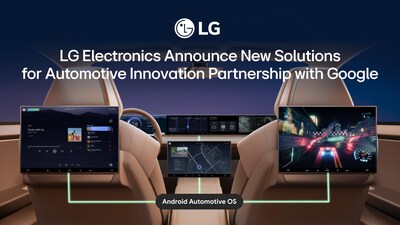
Showcasing LG's AAOS-Based Innovations
A new range of solutions is built on Android Automotive OS (AAOS) and AAOS SDV technologies. While AAOS SDV enables software to define and control core vehicle functions from driving performance and convenience features to safety systems, AAOS serves as the foundation for delivering infotainment experiences to passengers.
Enabling Seamless Multi-Display Experiences with a Single SoC
A key element is a new solution for simultaneously controlling multiple in-vehicle displays. Powered by Qualcomm Technologies' next generation Snapdragon® Cockpit Platform, LG's solution offers clear, vibrant images and smooth, stable performance enabling a seamless experience across navigation, vehicle information, and entertainment.
Unlike conventional in-vehicle display systems, which require a separate control chip for each screen, LG's AAOS-based solution can simultaneously control multiple displays with different aspect ratios using only a single system-on-chip (SoC). Leveraging LG's efficient resource allocation technology and system load optimization capabilities, the solution supports automakers to significantly reduce the cost of deploying multi-display in-cabin systems.
Delivering Personalized and Intuitive In-Cabin Experiences
LG's technology allows each person in the vehicle to view different content at the same time. For example, the driver can use navigation on the main display while the front-seat passenger watches YouTube, and the rear-seat passengers enjoy live TV content on their respective screens. The solution also supports individual user login accounts, personalized settings, content sharing and parental controls, enabling a more customized and flexible in-cabin entertainment experience for every passenger.
Additionally, LG has enhanced its voice command-based user interface to provide easier control in large panoramic dashboard environments. With simple spoken commands, users can adjust screen layouts, control key vehicle functions, launch apps and manage system volume. The reduced need for touch interaction contributes to improved convenience and safety in-cabin.
Strengthening Collaboration With Google for the SDV Era
Google executives commended LG's solution for its stable performance, differentiated user experience and ability to support cluster and media entertainment functions through a single SoC.
The solution also received a favorable evaluation for its flexibility in various SoC environments, its potential suitability for a wide range of automotive applications, and its broad chipset compatibility. The positive response reaffirmed the strength of LG and Google's partnership and signaled further opportunities for collaboration.
"LG's solution clearly demonstrated how AAOS can enable more flexible, intelligent and engaging in-vehicle experiences," said Patrick Brady, vice president of Android Automotive at Google. "Its seamless multi-display integration, intuitive voice controls and stable performance powered by a single SoC stood out, and we look forward to continuing our collaboration with LG to advance innovation for the SDV era."
"We are honored that our technological expertise and commitment to customer experience innovation have been recognized," said Eun Seok-hyun, president of the LG Vehicle Solution Company. "Through continued collaboration with Google and other major global tech partners, LG will continue to deliver differentiated in-vehicle customer experiences."
About LG Electronics Vehicle Solution Company
The LG Vehicle Solution Company (VS) is bringing LG's unique mobility innovations to the automotive industry. As a trusted and innovative partner, the company provides intelligent solutions including head units, displays, connectivity, ADAS vision systems, and software solutions integrating human-centered AI and automotive engineering into the modern AI/software-defined vehicle. Committed to "Driving better future mobility," the company has diversified its portfolio to further strengthen its capabilities, including automotive lighting systems, e-powertrain and cybersecurity. For more information, visit www.LG.com/global/mobility. To stay updated with the latest news, subscribe to the LG mobility newsletter, LG Loop at www.LG.com/global/mobility/newsletter and follow the LG VS Company LinkedIn channel at www.linkedin.com/company/lgvehiclesolution.
Photo - https://mma.prnewswire.com/media/2988506/LG_Google_GAPB_2026_MUMD_demo_F.jpg
 View original content:https://www.prnewswire.co.uk/news-releases/lg-electronics-announces-new-solutions-for-automotive-innovation-partnership-with-google-302783807.html

Thyssenkrupp zieht beim geplanten Verkauf seiner Stahlsparte an den indischen Konkurrenten Jindal vorerst die Reißleine. Beide Unternehmen haben vereinbart, die seit September laufenden Gespräche auszusetzen. Nach Angaben des Essener Industriekonzerns soll die Neuaufstellung von Thyssenkrupp Steel nun aus eigener Kraft konsequent weiterverfolgt werden. Konzernchef Miguel López betonte, die Voraussetzungen für eine profitable Fortführung des Geschäfts seien „so gut wie lange nicht mehr“.
Im Hintergrund steht ein deutlicher Stimmungsumschwung im europäischen Stahlsektor. Thyssenkrupp verweist auf „große Fortschritte bei der Neuausrichtung“ des Segments und ein deutlich verbessertes Umfeld. Die Europäische Union habe die Bedeutung der Stahlproduktion für die Resilienz industrieller Wertschöpfungsketten erkannt und den Willen bekundet, die europäische Stahlindustrie stärker gegen globale Überkapazitäten und Dumping abzuschirmen. Zudem will Brüssel die Umstellung auf eine klimafreundliche Stahlproduktion weiter unterstützen.
Auch operativ hat sich die Lage bei Thyssenkrupp Steel zuletzt aufgehellt. Die Sparte, historischer Kern des Ruhrkonzerns, legte im laufenden Geschäft zu. Parallel läuft jedoch ein tiefgreifender Umbau: Zur Sanierung des Bereichs sollen in den kommenden Jahren bis zu 11.000 der rund 26.000 Stellen gestrichen oder ausgelagert werden. López hatte bereits zuvor erklärt, je erfolgreicher die Neuausrichtung umgesetzt werde, desto attraktiver werde das Stahlgeschäft für Kapitalmarkt und Investoren – „ob mit oder ohne Jindal“.
Der vorläufige Verkaufsstopp bedeutet keinen endgültigen Verbleib der Stahlsparte im Konzern. Mittelfristig hält Thyssenkrupp an dem Ziel fest, sich vom Stahlgeschäft zu trennen. Gewerkschaften wie die IG Metall drängen derweil auf Klarheit und fordern ein Ende der Verkaufsüberlegungen ohne „Hintertür“. Sie verlangen Gespräche über ein Modell, mit dem sich der Stahlbereich eigenständig und aus eigener Kraft verselbstständigen könnte. Während frühere Versuche für einen Verkauf, ein Joint Venture oder einen Börsengang gescheitert sind, setzt das Management nun darauf, den Wert des Bereichs vor einem möglichen nächsten Schritt weiter zu steigern.