ZHUBEI CITY, June 1, 2026 /PRNewswire/ -- Airoha Technology today announced its inaugural exhibition at the ePaper Pavilion during Computex 2026. Leveraging 20 years of deep technological expertise in wireless transmission, Airoha's Bluetooth® audio chips have earned widespread adoption and validation from global Tier-1 acoustic brands.
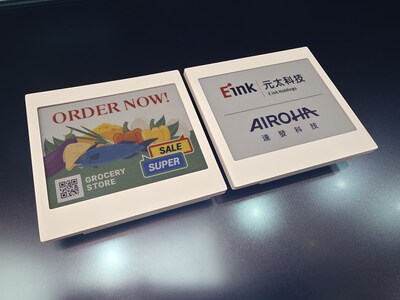
Building on this robust foundation, Airoha is expanding its footprint in the "Short-range Wireless" IC market in 2026, officially extending its reach from audio into Bluetooth® data transmission. Markedly, Airoha is the world's first IC designer to realize the 4.2-inch Ripple™ ESL (Electronic Shelf Label) chip, demonstrating its exceptional wireless technology prowess in anti-interference and transmission reliability.
Unlocking Diverse Commercial Scenarios: Global Debut of the 4.2-Inch Ripple™ ESL
E Ink, the global leader in ePaper display technology, continues to pioneer new form factors for ESL products. Leveraging E Ink's innovative waveform and algorithm architecture, the two companies are jointly showcasing the Ripple ESL, a solution engineered to mitigate flashing. This technology utilizes a wave-like "Ripple" animation effect for screen transitions, significantly reducing the flashing sensation typical of traditional ePaper page turns. This delivers smoother visual updates—crucial elements for dynamic Retail Media Networks (RMN) and point-of-purchase advertising.
"E Ink continuously refines ePaper technology to enhance color performance, further driving the penetration of ePaper applications in the advertising sector," said JM Hung, General Manager of E Ink. "For our first small-format ESL product, we partnered with Airoha Technology, an IC design powerhouse renowned for its robust Bluetooth® wireless stability and exceptional anti-interference capabilities. Together, we are establishing a new technological milestone for diverse commercial applications across retail, logistics, and beyond."
The World's First Ripple ESL Chip: Airoha's New AB161x Bluetooth Series
Airoha Technology's newly launched AB161x series chips support all types of ESLs adopting the Bluetooth® SIG 5.4 standard. The exclusive new-generation 4.2-inch small-format Ripple™ ESL not only diversifies application environments but also specifically fulfills the emerging retail media demand for shelf labels that double as high-impact visual advertising mediums.
"Over the past two decades, Airoha Technology has accumulated rich wireless communication technology and customer service experience in the Bluetooth® audio sector," stated YuChuan Yang, Senior Vice President at Airoha Technology. "Our Bluetooth® transmission chips demonstrate strong commercialization capabilities across diverse wireless communication scenarios. Not only have we expanded into the ESL ePaper application market, but we have also achieved mass production in our gaming HID (Human Interface Device) product lines. Centered on our deep foundational Bluetooth® wireless technology, we will continue to collaborate with global partners to pioneer broader commercial application markets."
 View original content:https://www.prnewswire.co.uk/news-releases/airoha-technology-partners-with-e-ink-for-global-debut-of-4-2-inch-ripple-esl-at-computex-2026--302786979.html

In Thüringen ist ein großangelegtes Forschungsprojekt zur nächsten Generation der Nanostrukturierung gestartet. Wissenschaftlerinnen und Wissenschaftler der Technischen Universität Ilmenau, der Friedrich-Schiller-Universität Jena und des Fraunhofer-Instituts für Angewandte Optik und Feinmechanik (IOF) in Jena entwickeln gemeinsam eine Hochpräzisionsmaschine, die Nanostrukturen auf Flächen von bis zu einem Quadratmeter erzeugen und vermessen soll. Die geplante 3D-Nanolithographie- und Nanomessmaschine (3D-NLM) soll dabei eine Positionierungsgenauigkeit erreichen, die kleiner ist als ein Atom. Die Deutsche Forschungsgemeinschaft (DFG) unterstützt die erste Projektphase bis 2027 im Rahmen des Programms „Neue Geräte für die Forschung“ mit vier Millionen Euro.
Mit dem Vorhaben zielt das Konsortium auf eine Größenordnung, die bestehende Anlagen deutlich übertrifft. Bisher lassen sich hochpräzise Nanostrukturen auf photonischen Bauteilen nach Angaben der Projektbeteiligten nur bis zu einem Durchmesser von etwa 30 Zentimetern zuverlässig herstellen. Die neue Anlage soll Bearbeitungen und Messungen von Bauteilen mit Kantenlängen von bis zu einem Meter ermöglichen – und damit eine mehr als dreifache Vergrößerung der nutzbaren Fläche erschließen. Die Entwicklungsarbeiten an der Maschine sind angelaufen; das Gesamtprojekt ist in drei Phasen bis 2032 angelegt.
Nanostrukturen gelten seit rund zwei Jahrzehnten als Schlüsseltechnologie, weil sie Licht gezielt beeinflussen können, indem sie dessen Wellenlänge und Ausbreitung steuern. Solche Strukturen finden sich bereits heute in großflächigen Bauteilen, etwa in Displays moderner Fernsehgeräte, die auf Nanotechnologie basieren. Nach Einschätzung der Forscherinnen und Forscher reicht die Genauigkeit bestehender industrieller Lösungen jedoch nicht aus, um künftige Anforderungen in zentralen wissenschaftlichen und technologischen Anwendungsfeldern zu erfüllen.
Die in Thüringen entstehende 3D-NLM soll genau diese Lücke adressieren. Perspektivisch könnte die Maschine zur Fertigung und Charakterisierung elektronischer und photonischer Schaltkreise ebenso eingesetzt werden wie zur Herstellung von Hochleistungsoptiken für die Erdbeobachtung. Auch in der Energieforschung sehen die Projektpartner potenzielle Einsatzfelder. Durch die Kombination aus großflächiger Bearbeitung und atomnaher Präzision erhoffen sich die Beteiligten einen technologischen Sprung, der sowohl der Grundlagenforschung als auch der Entwicklung neuer Komponenten in der Optik- und Elektronikindustrie zugutekommen könnte.